Anti-corruption reforms in Ukraine have proceeded at a remarkable pace during wartime. This U4 Issue examines the sustainability of that agenda. Ukraine’s responses to the ongoing Russian aggression – including operating under martial law – rightly prioritise security but they also constrain transparency and accountability, heightening corruption risks and narrowing the space for oversight. So, with the future of Ukraine’s anti-corruption efforts uncertain and unpredictable, we must examine the different ways in which these might unfold. What strategic interventions are needed now so these kinds of anti-corruption efforts can become self-reinforcing, sustainable, and responsive to future domestic challenges? Reframing anti-corruption as a policy arena
Sustainability is a function of many things including resources, capacities, and sound policy design, but it is also a result of the extent to which – and the ways in which – anti-corruption is embedded in ongoing and future social and political dynamics. To offer a perspective on this, we suggest moving beyond seeing anti-corruption as a set of reforms – reframing that agenda in Ukraine as a ‘policy arena’: a social and political space in which various actors interact to shape patterns of policymaking and implementation, helping explain why reforms succeed, stall, are reshaped, or are reversed.
Since 2014, Ukraine’s anti-corruption ‘policy arena’ has evolved into a complex ecosystem. It spans enforcement, prevention, public finance, service delivery, and reconstruction, involving specialised institutions, civil society, local authorities, state-owned enterprises, international partners, and political leaders. How may the policy arena evolve over the next five years?
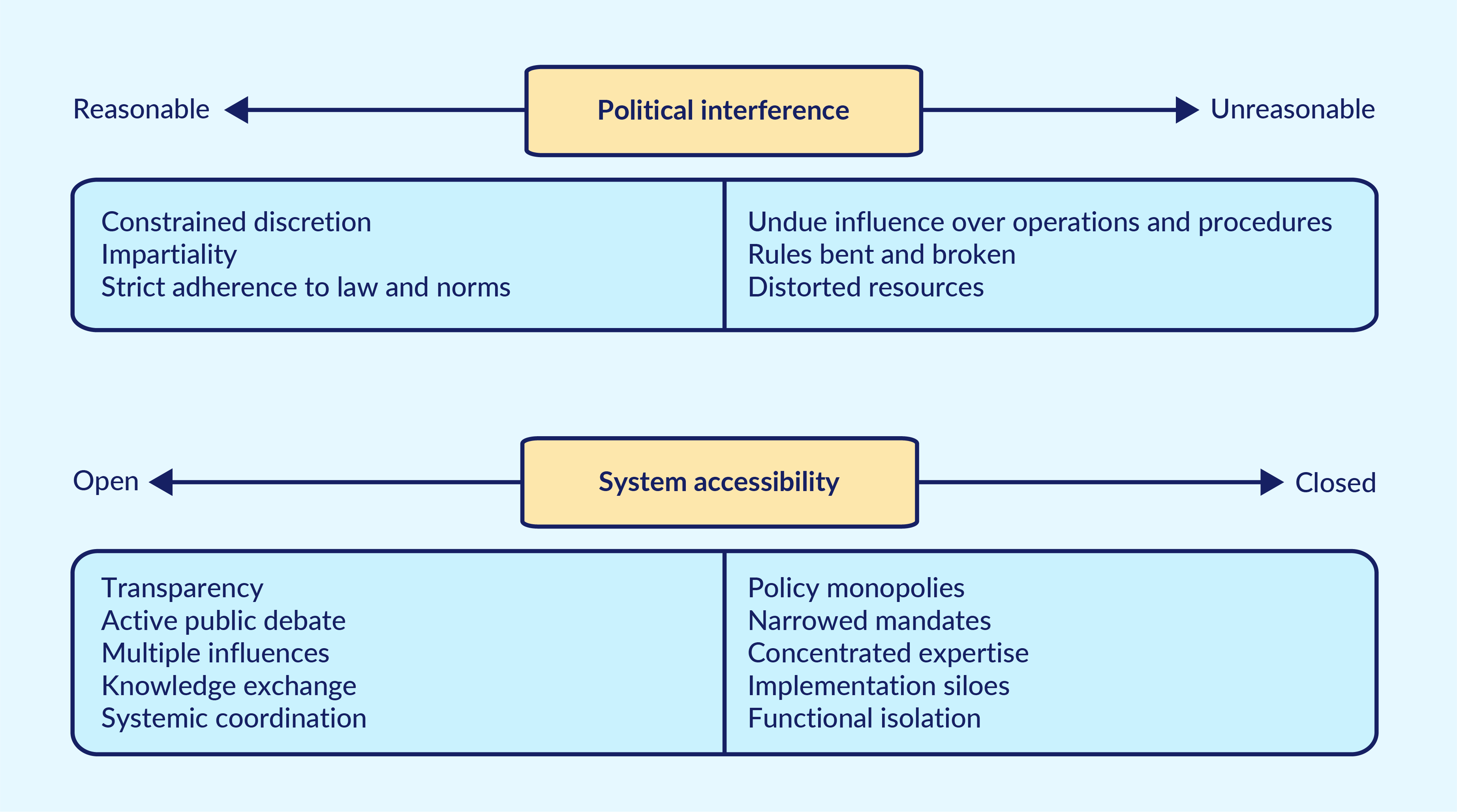
To distinguish between different policy arenas, two dimensions in Ukraine matter above all: the level of political interference and the level of openness of the policy arena.
Figure 1: Ukraine’s possible anti-corruption futures will be defined by the level of political interference and the level of openness
We set out four alternative policy arenas – possible paths that Ukraine might follow – to explore how anti-corruption may evolve. The most sustainable arena is an open one, free from undue political interference: the ‘maturity and innovation’ policy arena. Each of the other three policy arena types – ‘tension and uncertainty’, ‘siloed’, and ‘decay’ – all present challenges that could make anti-corruption unsustainable. These are ideal, stylised types: in reality, no policy arena will operate exactly to a type, but it is nevertheless possible to use this framework to identify the most likely policy arena.
Figure 2: There is one desirable policy arena for Ukraine’s anti-corruption future – and three that should be avoided
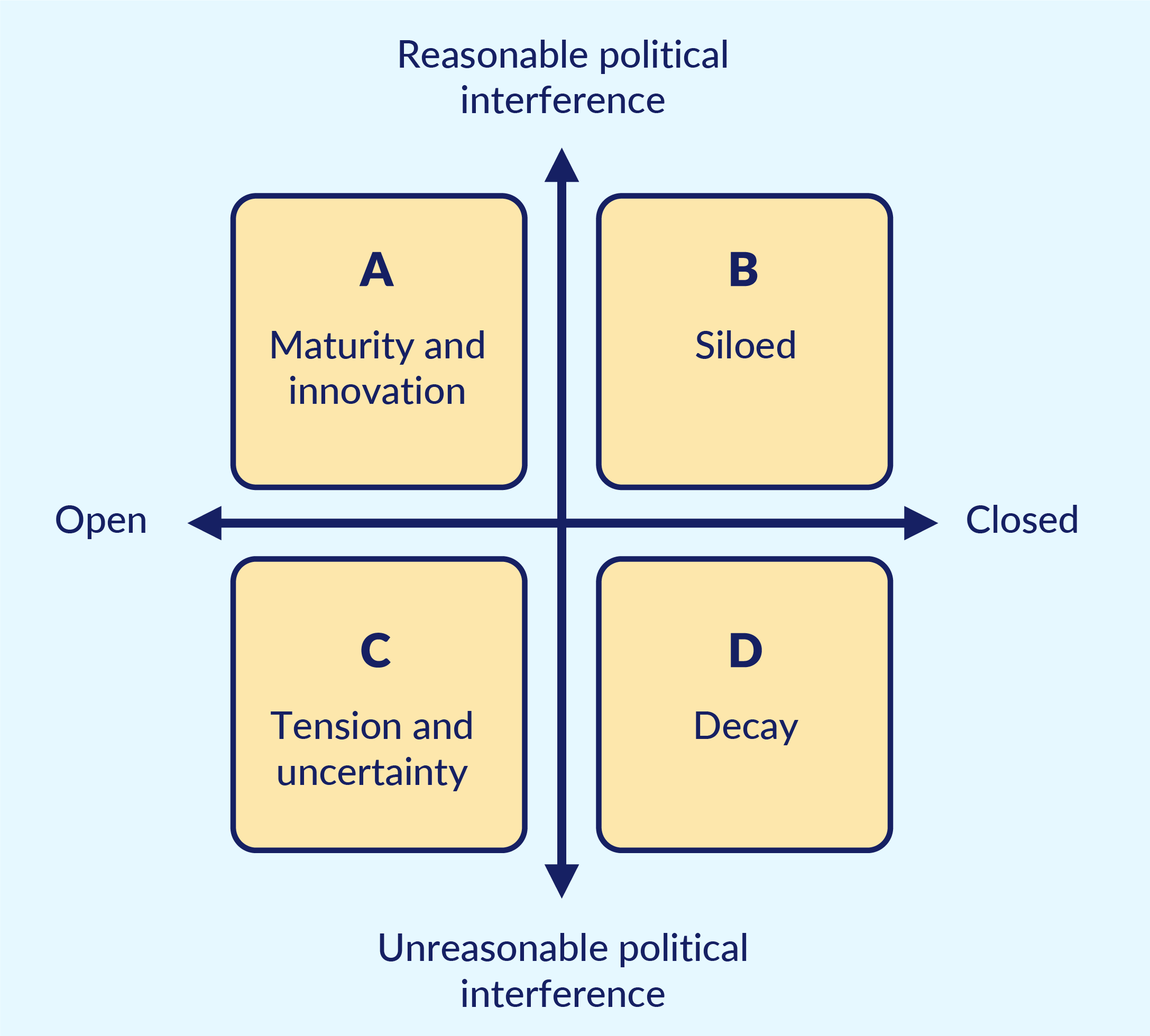
Scenario A: Maturity and innovation
The most sustainable form of anti-corruption: an independent, trusted anti-corruption system embeds integrity across governance, boosts innovation, and makes corruption riskier and less rewarding.
Scenario B: Siloed
Anti-corruption systems become less sustainable over time as Ukraine keeps the architecture of reform but loses its collective spirit, as the specialised anti-corruption organisations struggle to influence sectoral policies and reconstruction at scale.
Scenario C: Tension and uncertainty
The way in which the policy arena develops is not favourable to sustained anti-corruption, but it remains possible through lively public debate. Each reform step involves high transaction costs and is dependent on turbulent and shifting coalitions.
Scenario D: Decay
The anti-corruption agenda is hollowed out, enabling elite control, rent-seeking in reconstruction, and largely symbolic reforms that sustain external legitimacy while real accountability fades.
Determining anti-corruption trajectories in Ukraine
According to the policy arena perspective, the structure of the arena depends on the interplay and relative influence of the most important actor groups – and on the various mechanisms they can use to shape it. This section offers a model that identifies those actors and explains their influence. In a way, this section can be thought of as constructing a political economy model that pinpoints the likely sources of political will for an open policy arena free from undue political interference.
Shaping the anti-corruption policy arena: The kite model
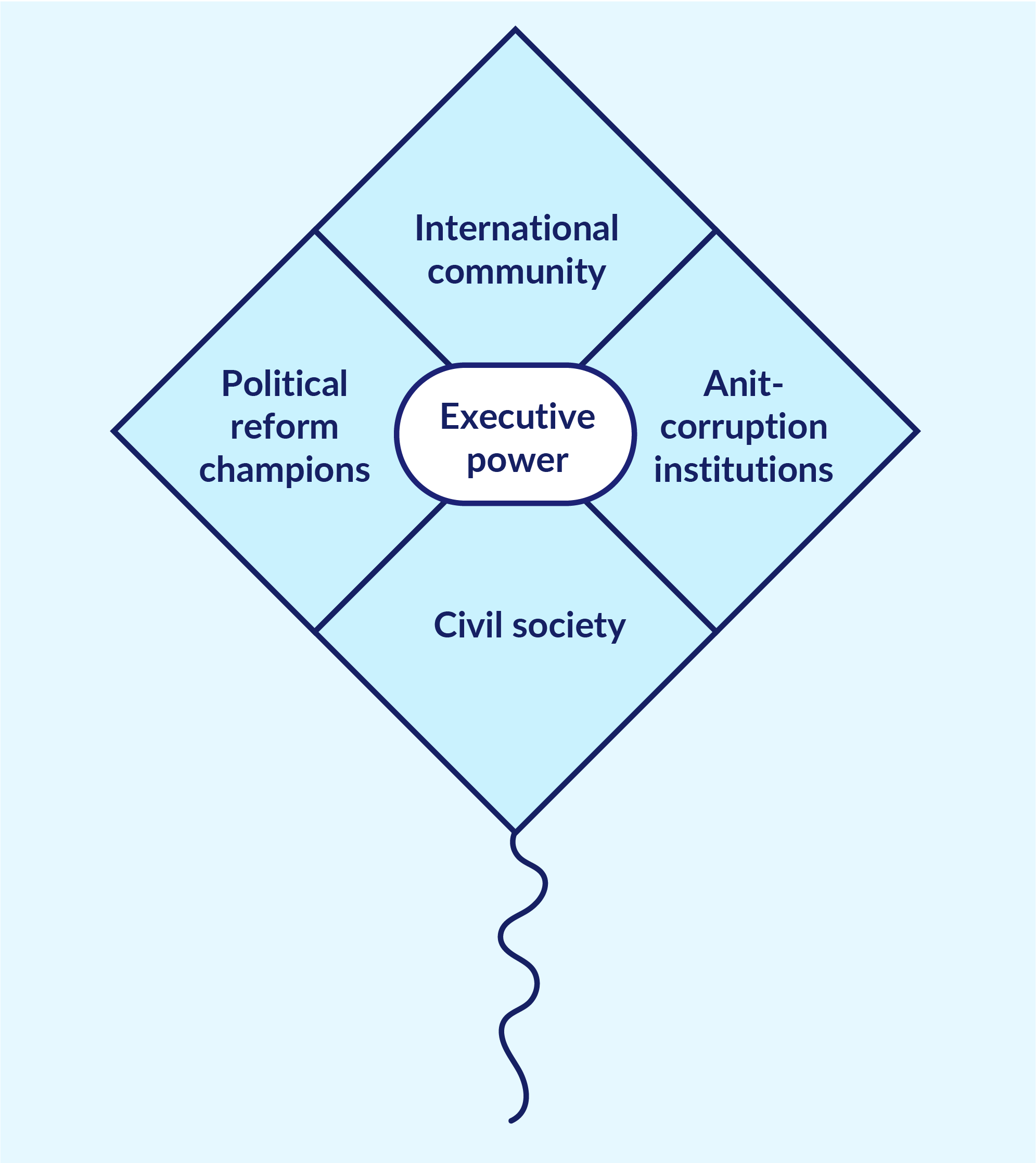
For many analysts of Ukraine’s anti-corruption policy arena, the ‘sandwich model’ has been the preferred framing: political actors are shaped by the international community ‘from above’ and by civil society ‘from below’. We offer a new analytical framework – the ‘kite model’ – that evolves the sandwich model in two main ways. First in the centre of the model, we reassert the role of executive power. Executive power – centred on the Cabinet, ministries, and the President– largely determines Ukraine’s anti-corruption policy arena. Unlike the ‘sandwich model’, which emphasises civil society and international actors, this approach highlights the executive’s central role in enabling, constraining, or reversing reforms through appointments, budgets, agenda-setting, and coordination.
In Ukraine, recent attempts to weaken anti-corruption institutions and wartime centralisation have increased executive influence and reduced the openness of the policy arena. Second, we place executive power in a broader constellation of influences, to include reformist politicians and the specialised anti-corruption bureaucracy. The sandwich becomes a diamond or, with the executive at the centre, a kite.
Figure 3: The kite model offers a new way to conceptualise political influence around the executive
How the four points of the kite model can reduce interference and support openness
The future risk for anti-corruption can be summed up as one of isolation: that the sector becomes siloed and thus unable to produce tangible results for society, and that the four groups in the kite model are unable to assert themselves over the excesses of executive power. Although the executive exerts significant influence, four actors can counterbalance interference and encourage a more open and accountable policy arena, but each of these also face constraints.
Civil society
Since 2014, civil society organisations have shaped anti-corruption reforms through expertise, monitoring, advocacy, and public mobilisation. Their influence depends on political access, public trust, and donor support, but wartime restrictions and resource constraints have weakened their capacity.
International actors
International partners influence reform through conditionality, technical assistance, funding, and the promotion of rule-of-law norms. However, their leverage is limited by wartime realities, political constraints, and declining international attention and resources.
Specialised anti-corruption institutions
Institutions such as NABU, SAPO, NACP, HACC, and ARMA are not merely passive recipients of political will; they can resist interference, build alliances, and shape the policy agenda. Their effectiveness depends on resources, legitimacy, institutional independence, and public trust.
Reform champions
Reform-minded politicians and officials have been crucial drivers of change since 2014, advancing reforms from within state institutions. Their influence remains important but fragile, as reformers can face political resistance, marginalisation, or removal when they challenge entrenched interests.
Strategic considerations for anti-corruption
Reframing anti-corruption dynamics through the kite model opens up possibilities for how to maintain an open and collaborative anti-corruption policy space that is protected from excessive political intrusion. Primarily, it shows that the single most important strategic transition that anti-corruption should make is towards broader-based domestic ownership. To help achieve this, practitioners could: 1) Shape the domestic political economy using the kite model as a diagnostic. 2) Develop a shared domestic vision for anti-corruption. 3) Further expand anti-corruption in sectors. 4) Support social capacity to strengthen the anti-corruption agenda. 5) Ensure that internationally-led processes are mediated locally. 6) Bring the anti-corruption policy arena together.